Introduction
Marketing is the backbone of every successful business. Whether you run a startup, local company, service business, or large enterprise, marketing helps attract customers and increase revenue. The debate between digital marketing and traditional marketing has become more important than ever because consumer behavior has changed dramatically. Most people now search online before making purchasing decisions. However, traditional advertising channels still influence customers in many industries. This guide explains both approaches, compares their strengths and weaknesses, and helps businesses choose the right strategy for sustainable growth.
What Is Traditional Marketing?
Traditional marketing includes all offline promotional activities such as newspapers, magazines, television commercials, radio ads, brochures, flyers, direct mail, billboards, event sponsorships, and outdoor advertising. These methods have been used for decades and continue to provide visibility and credibility for businesses.
Advantages of Traditional Marketing
- Strong local visibility.
- High credibility among certain audiences.
- Effective for mass awareness campaigns.
- Useful for reaching older demographics.
- Tangible promotional materials customers can keep.
Disadvantages of Traditional Marketing
- Higher costs.
- Limited targeting capabilities.
- Difficult performance measurement.
- Lower engagement opportunities.
- Less campaign flexibility.
What Is Digital Marketing?
Digital marketing involves promoting products and services using online channels. It includes SEO,
Google Ads, social media marketing, content marketing, email marketing, influencer marketing,
mobile marketing, and video marketing. Businesses use digital marketing to reach customers online
and generate measurable results.
Advantages of Digital Marketing
- Global audience reach.
- Lower marketing costs.
- Precise targeting options.
- Real-time analytics and tracking.
- Better customer engagement.
- Scalable campaigns.
- Long-term benefits through SEO.
Digital Marketing vs Traditional Marketing: Cost Comparison
Traditional marketing often requires significant budgets for television commercials, newspaperplacements, and billboard rentals. Digital marketing allows businesses to start with small budgets
and increase spending based on campaign performance. Small businesses benefit greatly from this
flexibility because they can test strategies before scaling.
Audience Reach Comparison
Traditional marketing usually focuses on local or regional audiences. Digital marketing can reach customers worldwide through search engines, websites, and social media platforms. Businesses can target customers in specific countries, cities, or neighborhoods while maintaining global
visibility.
Targeting Capabilities
Traditional advertising reaches broad audiences. Digital marketing allows targeting based on age, gender, location, interests, behavior, purchasing intent, and device usage. This precision increases conversions and reduces wasted ad spend.
Performance Tracking
One of the biggest advantages of digital marketing is measurability. Businesses can track impressions, clicks, conversions, leads, sales, customer acquisition costs, and return on investment. Traditional marketing often relies on estimates and surveys.
Customer Engagement
Digital channels encourage direct communication. Customers can comment on posts, send messages, leave reviews, and interact with brands in real time. Traditional marketing generally provides one-way communication.
Why Digital Marketing Is Important in 2026
Modern consumers spend significant time online. They search on Google, watch videos, read reviews, compare products, and follow brands on social media. Businesses that ignore digital marketing risk losing visibility and customers to competitors who invest in online channels.
The Power of SEO
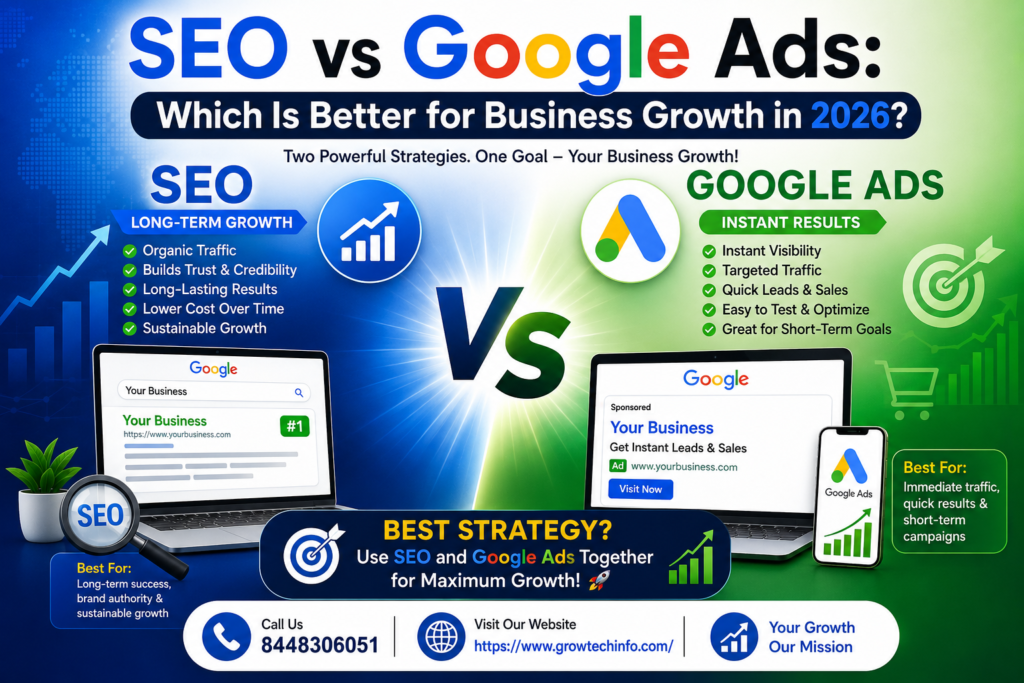
Search Engine Optimization is one of the most valuable digital marketing strategies. SEO improves website visibility in search engine results. When customers search for products or services, optimized websites attract traffic without paying for every click. Benefits include long-term traffic growth, higher credibility, improved user experience, and lead generation.
Content Marketing and Business Growth
Content marketing involves creating valuable articles, guides, videos, infographics, and resources that help customers solve problems. High-quality content improves search rankings, builds trust, and supports customer decision-making. Businesses that consistently publish useful content often achieve stronger online authority.
Social Media Marketing
Social media platforms such as Facebook, Instagram, LinkedIn, YouTube, and X provide opportunities to engage audiences directly. Businesses use these platforms to build awareness, generate leads, increase website traffic, and strengthen customer relationships. Social media also offers valuable audience insights.
Email Marketing
Email marketing remains one of the highest ROI digital marketing channels. Businesses can
nurture leads, promote products, share updates, and maintain relationships with existing
customers. Personalized email campaigns often improve engagement and conversions.
Google Ads and Paid Advertising
Paid advertising allows businesses to appear immediately in front of potential customers. Google Ads, display campaigns, shopping ads, and social media advertising help businesses reach highly targeted audiences. These campaigns provide measurable results and flexible budget control.Situations Where Traditional Marketing Still Works
Traditional marketing remains valuable for local awareness campaigns, community engagement event promotions, outdoor branding, and reaching audiences that are less active online. Large corporations often combine television, radio, and outdoor advertising with digital campaigns for maximum visibility.
Integrated Marketing Strategy
The most successful businesses rarely choose only one method. Instead, they combine traditional and digital marketing. A billboard may direct customers to a website. A television commercial may promote a social media campaign. Printed brochures can include QR codes leading to landing pages. Integration creates a seamless customer experience.
Common Marketing Mistakes
- Ignoring SEO.
- Targeting everyone instead of a specific audience.
- Failing to track campaign performance.
- Inconsistent branding across channels.
- Neglecting mobile optimization.
- Not testing and improving campaigns.
Digital Marketing ROI
Digital marketing provides detailed data for evaluating performance. Businesses can calculate cost per lead, conversion rates, customer acquisition costs, and revenue generated. These insights support better decision-making and continuous improvement.
Future of Marketing
Marketing continues to evolve through artificial intelligence, automation, voice search, video content, and personalization. Businesses that adapt quickly to technological changes are more likely to achieve long-term success. Digital marketing will continue expanding because consumers increasingly rely on online channels for information and purchases.
Frequently Asked Questions
Q1. Is digital marketing better than traditional marketing?
For most businesses, digital marketing offers better targeting, lower costs, and measurable results.
Q2. Which method is cheaper?
Digital marketing is usually more affordable.
Q3. Can small businesses benefit from digital marketing?
Yes, digital marketing allows small businesses to compete effectively with larger companies.
Q4. Does traditional marketing still work?
Yes, especially for local branding and awareness campaigns.
Q5. Can both methods be used together?
Absolutely. An integrated strategy often produces the best results.
Conclusion
The debate between Digital Marketing vs Traditional Marketing is not about declaring one method
completely superior. Both approaches have strengths and weaknesses. However, digital marketing
provides unmatched targeting, flexibility, measurable performance, and scalability. Businesses
seeking sustainable growth, quality leads, and higher ROI should prioritize SEO, content marketing,
social media marketing, and paid advertising while using traditional marketing strategically where
appropriate. In 2026 and beyond, digital marketing remains the foundation of modern business
success.